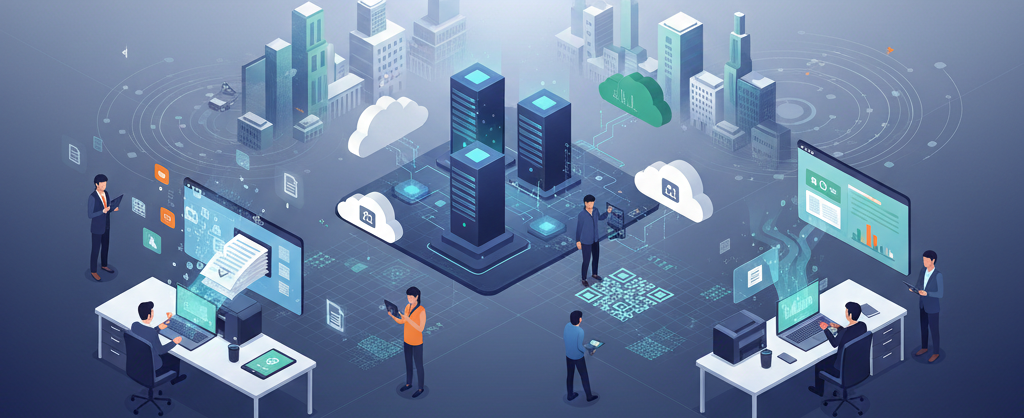

India is digitizing faster than ever.
UPI has replaced wallets. Aadhaar has transformed identity. Government services that once required queues and files are now available on screens. From startups to public sector offices, digital systems are becoming the backbone of how the country works.
Yet, inside many offices, one thing hasn’t changed.
Files still move by hand. Documents are printed “just in case.” Approvals wait because a file hasn’t physically reached the right desk. Important records exist—but are buried inside cupboards, boxes, or server folders no one wants to open.
This contradiction sits at the heart of India’s digital journey.
And it’s exactly why paperless offices are no longer a trend—they are a necessity for India’s digital economy to truly scale.
Digital India Cannot Run on Paper Files
India’s economy is built on speed, scale, and volume.
Millions of invoices are generated every day. Government departments handle massive citizen data. Banks, utilities, healthcare providers, and enterprises process documents continuously. When these documents rely on paper, delays become inevitable.
A document has to be printed, signed, carried, stored, searched, and retrieved. Each step depends on human availability and physical presence.
In a country aiming to be a global digital powerhouse, paper-based operations are no longer sustainable.
What “Paperless” Really Means in the Indian Context
Here’s a common misconception that paperless offices simply mean scanning documents and saving PDFs.
That’s not transformation. That’s storage.
True paperless operations mean documents are born digital, understood digitally, moved digitally, approved digitally, and archived digitally—with intelligence built in.
This is where modern document management platforms like ARODOC come into play.
Instead of treating documents as static files, ARODOC treats them as living sources of information. AI-powered OCR, intelligent classification, automated workflows, and secure access ensure documents work for people—not the other way around.
For India’s scale, this intelligence is critical.
From Government Offices to Enterprises: The Shift Is Already Happening
Across India, the shift has already begun.
Government departments are digitizing records and citizen services. Enterprises are moving toward digital workflows. Startups are born paperless by default. Even traditional industries are realizing that paper is no longer a sign of seriousness—it’s a sign of inefficiency.
Paperless transformation works only when documents are managed intelligently, workflows are automated, and systems talk to each other seamlessly. This is where ARODOC acts as the foundation, not just another tool.
Why ARODOC Fits India’s Paperless Future
ARODOC is built for real-world Indian business complexity.
It understands high document volumes, diverse formats, multilingual requirements, compliance needs, and hybrid environments where legacy systems coexist with modern platforms.
By combining AI-powered document management, intelligent workflows, secure storage, and output control, ARODOC enables organizations to move toward paperless operations without disruption.
It doesn’t force change overnight.
It enables Digital transformation step by step—with confidence.
Ready to take your first step toward a paperless office?
Discover how ARODOC can help you making your organization digitally Transformed, Faster and smarter.